Music

Marchant, Pembroke… (well, SDUC Lampeter, the Poly of Wales, Lancaster and Birmingham City University, really)

On Wednesday evening I did a talk with Richard Beard under the auspices of the National Academy of Writing at Pembroke College, Cambridge, England, Yurp. The college were kind enough to invite my wife too.

To say the college made a fuss of us would be an understatement. They could not have been lovelier. The Senior Tutor Mark Wormald took time out from an insanely busy schedule to ask us for tea in his study before the talk. The seventy-strong crowd were gripped by Richard’s Masterclass, and laughed at my jokes. Sitting right in my eye line was Edward Bankes, who is a member of the current Pembroke University Challenge team. I recognised him at once, as my wife and I are supporting Pembroke this series, and I did that thing that light entertainers do on telly when Kerry Katona is in the audience and they say ‘Kerry Katona is in tonight Ladies and Gentlemen’ and the camera whizzes round and Kerry stands up and smiles and everyone claps. Nobody stood or clapped, but Edward was very nice and smiley about me pointing him out as ‘that bloke off the telly.’

After the talk, the college threw us a drinks party. My wife and I went over to Edward, and we told him we were supporting Pembroke all the way. He told us that the recording took place last April, so he already knew the result, but that he was sworn to secrecy. I told him that my wife was on the Trinity team back in the 80′s. My wife told him that I had twice been the subject of a question on University Challenge. I’m sure he was almost as thrilled to meet two such paragons as we were to meet him.

The college were kind enough to invite us all to dine at High Table after the drinks party. Mark Wormald took us into the Senior Parlour, and introduced us to the Master, a kindly looking chap in his mid-sixties. A butler/maitre de bloke called us into dinner. Richard and I were invited to follow the Master. As he led us in, the students fell silent. The butler bloke gave him a Latin prayer to read off a card. Then we sat down, Richard on the Master’s right hand, and I on his left.

The Master apologised to me for missing the talk, but explained that he had been getting ready for a trip to the US the following morning. I asked him why he was going; he explained that he was going to Rhode Island to discuss the possibilities of setting up some scholarships, given that Roger Williams, the founder of Rhode Island was a Pembroke graduate. He asked me what I was working on. I told him that it was, in a sense, a history of the British counter-culture, from 1956 to 1994. His face lit up.

‘I was a student at Cambridge from 1963 to 1966, and I experienced the wonderful liberation of those times. We felt so free; free from constraint, free from worry too. I hope you’ll be writing about the influence of the French New Wave cinema. Just as important to my generation in opening up ideas about new ways of living as music in my opinion. And even though my work took me away from Britain for many years, I always knew that I’d lived through those remarkable times, and that they had changed everything for me.’

‘What was your work?’ I asked.

‘Oh,’ he said. ‘I was head of British Intelligence. I ran MI6.’

Share

Spitfires on the Line.

I’m in the middle of making a short series for Radio Four with producer Mary Ward-Lowery about a series of journeys we’re taking along the line drawn by Prof. Danny Dorling of Sheffield University which divides the north from the south.

We have met some wonderful people, including the sagacious Sir Michael Darrington, esrtwhile boss of Greggs, the orchidaceous psycho-geographer Tina Richardson in Leeds, the makes-you-glad-to-be-alive poet David Morley in Warwick, and, in Louth, the funniest man on Earth, top biscuit entrepreneur Graham Fellows.

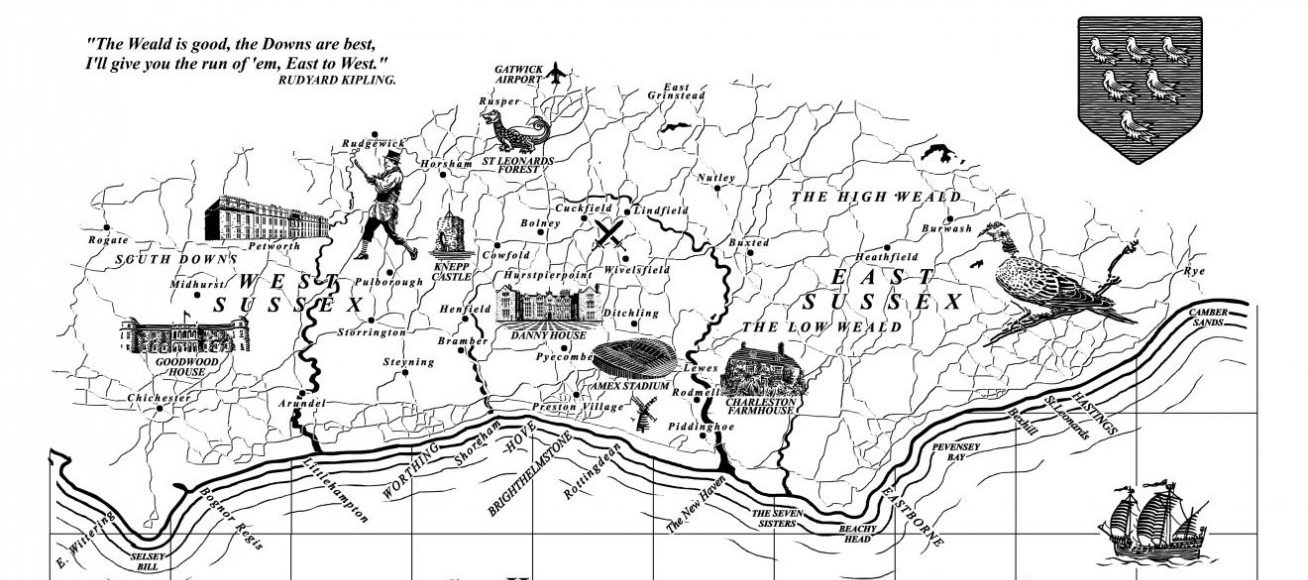
Danny Dorling is a little vague about the exact moment the line hits the Lincolnshire coast; ‘Somewhere between Cleethorpes and Mablethorpe,’ he told us; but if you look closely at the map, the line seems to cross the coast round about Tetney; very close to where the Meridian Line leaves the coast heading north on its journey up from Peacehaven.

So Mary and I drove out to Cleethorpes, and then south a few miles to Tetney Lock. On the way, we listened to Vikram Seth on Desert Island Discs. He chose as his favourite recording nightingales singing in a Kent wood in 1942. In the background, the sound of bombers on their way to Germany. It is incredibly moving.

I know a recording of nightingales when I hear one, because my friend Richard played me lots in an Oxfordshire car-park in the absence of real ones. And I know the sound of a bomber because shortly after the show ended, a Lancaster bomber flew over the car; and while we were interviewing some dog-walkers out by Tetney Lock (which we had finally chosen as our ‘starting point’), two Spitfires in formation flew low above our heads.

Apropos of nothing this story, I guess, except to say that this is the kind of coincidence that is so hard to pull off in fiction, even though they happen in life everyday, and to notice that the RAF are still much easier to hear in the countryside than nightingales.

Share

Something of the Night.

The new book is out. I’ve always done an introduction to the books, and posted them on this site; this is a first pass, really.

I got the idea for a book about the night in 2008, and envisaged taking a similar approach to the one I took in Parallel Lines and The Longest Crawl. This is to say, I’d travel and  I’d do a huge amount of reading around the history of my subject before I started writing. The travel would be easy; I’d visit, oh I don’t know, criminals and prostitutes, go to a sleep clinic, and fill a few shelves in a supermarket at night, that kind of thing, and then use carefully chosen historical examples from the hundred or so secondary sources which I’d read to illuminate my experiences.

I’d pitched and sold the idea before I found that, rather than hundreds of secondary sources, there is, in essence, just one, A. Roger Ekrich’s astounding history of nighttime, ‘At Day’s Close.’ I found that on day one. I also found Al Alvarez’s marvellous ‘Night’, where he did something pretty much identical to what I’d had in mind; and Sukhdev Sandhu’s ‘Night Haunts’, a fascinating and contemporary series of psycho-geographicalesque accounts of how people spent their nights in London. All on day one. Unhappy bunny.

Although I had access to some excellent primary sources, I didn’t feel that I wanted to go over the same ground as Alvarez or Sandhu, and I certainly didn’t want to regurgitate huge chunks  of Ekrich’s masterpiece; and I wasn’t sure how to avoid it. So I did something else. I wrote the story of my nights, my darkness, and hoped that it would resonate with readers. Set across the course of an intoxicated night in West Cork, it starts light, gets very dark, and ends with a ray of light (I hope).  So it’s a memoir, with some travel, rather than a travel book with a bit of memoir. It’s the most close-up and personal thing I’ve done, and I think that makes it all but uncategorisable.  Which is good, if you’re a writer, because it makes you think you’ve pulled off something original; but annoying if you’re a bookseller, maybe. I hope readers like it, and forgive me the crimes, stoned theology, attempts to visit hookers and night sweats; and I hope that if they go on to read Ekrich, Alvarez, and Sandhu, they agree, at least, that I tried to do something different with my nights.

Share

Puch Maxi Moped, tit rub (or tit-rub), triple cooked chips.

Once again. I’ve been looking at the search terms whereby people find this site. Luckily, the most popular search term is Ian Marchant, and the various permutations thereof. But what fascinates me is the other stuff people come looking for.

People visit this site looking for things like information on where to find the pub sign painted by Dora Carrington, Chesterton’s road poems, and for black forest gateaux recipes. The most popular recipe, though, that people come looking for is how to do triple cooked chips. Don’t know, really, is my answer. I just like them, and have said so on this blog.

In third position is tit-rub. Or tit rub. This is because my blog appears in tenth place on Google search for tit rubbing. I can only apologise to those tit rub fans who have been sent here; really, I’d stick with the first nine.

Running me a very close second, though, is ‘Puch Maxi’. Moped buffs are clearly even shorter of useful information than the tit-rub gang. I’m sorry I have nothing to give you. I rode one for a few months back in the seventies, yeah? It didn’t go well, alright? Can we leave it there? I really don’t want to talk about it, if that’s OK.  Some of my so-called ‘friends’ still dine out on their side-splitting stories of watching me ride the bastard, and I’ve just about had it.

I hope this nonsense stops, and that my readers enjoy this lovely festive picture of a computer squirting in a clown’s face.

Share

HSBC and the virtue of profit.

I think this blog is going to be about economics.  I’m not an economist. But since they seem to know bugger all anyway, I don’t see why any entirely unqualified bloke-in-the-pub shouldn’t chip in, and make just as little sense as anyone else.


The global economy is almost five times the size it was half a century ago. If it continues to grow at the same rate that it has over the last fifty years, the economy will be 80 times its current size by the year 2100.

Is that going to happen? It seems unlikely. So the rate of growth has to slow, doesn’t it? Or, what seems much likelier to me still, is that ‘growth’ will shrink and go into reverse. Already we learn that our living standards in the UK in 2011 are the same as they were in 2001. In those terms, there has been no growth for ten years.

To most economists, growth is a virtue, but I can’t find it listed as such in Aristotle, in any of the world’s religious systems, or in any humanist account of what virtue might be. You see things like justice, temperance, hope, compassion, equanimity,  cleanliness, etc. but no one, not even Ayn Rand, lists limitless profit and endless growth as virtues. In fact, limitless profit and profligate growth look a lot more like vices than virtues.

And yet bankers and politicians treat profit and growth exactly as though they were virtues, rather than monstrous vice.

HSBC, the World’s Local Bank, are closing their branch here in Presteigne. This year, we lost our biggest employer, and times are hard for the town. So the Presteigne branch of HSBC has lost business, and is no longer as profitable as it once was. Account holders, (like me), all got letters apologising for any inconvenience caused by forcing us on a 12 mile round trip to our nearest branch, by making our lives yet more impersonal through ‘internet banking’, by taking away the town’s only ATM. But, the letter implied, the thing is, HSBC Presteigne is not making as much profit as we’d like, so, as I’m sure you’ll understand, we are morally obliged to close it, because profit is our only virtue.

In their terms, HSBC are right to close their branch, a closure which will do great damage to our fragile economy, because they have  no striving after virtue other than the making of profit. Therefore, their terms are wrong. Limitless profit, cancerous growth – are not virtues. They celebrate only the vice of greed, which is not good in any sense of what a virtue might be.

Companies have the legal status of individuals. In the eyes of the law, HSBC is a person. Most persons are more interested in being virtuous (loving their children, for example, or trying to be just in their dealings with other people) than in simply piling up more profit. Either companies should lose their status as individuals, or they should start aspiring to virtue. Virtues such as compassion, justice or temperance, for example.

HSBC whine that they are answerable to their shareholders; that they only act on their shareholders’ behalf. Who are their shareholders? I very much think that you and I might be, through the agency of pension funds.  And who buys government bonds, the sale of which is faltering across the world, and is threatening to bring banks down,  banks like HSBC, with their £11.8 billion pre-tax 2010 profits? Pension funds buy bonds, so that government can fund pensions. Then governments pay back the pension funds at interest, so that the pension funds can fund pensions thirty, forty, fifty years from now.

Pension funds reach into the far future. Now that permanent unfettered growth is seen to be unattainable, pension funds  need to be concerned with virtue: cleanliness, (i.e, companies need to be environmentally responsible), honesty, compassion, temperance, and whatever else we might agree to be virtuous. They need to behave as individuals; as good neighbours, members of the community. Concerned with a wider idea of what well-being might mean in  thirty, forty, fifty years from now than profits. We all pay into these funds one way and another, so we all need to be able to have a say in how they invest our money.

Perhaps we need to examine whether or not pensions are themselves virtuous. Compassion towards the elderly certainly is, but does that necessarily mean a great pension for everybody? I’m not sure it does. Maybe we, all of us, legal persons like companies and useless hypocrites like myself, need to show greater compassion towards the young, and to teach them compassion for the elderly.

In Hindu tradition, the third stage of life is Vanaprastha. This stage begins when household duties come to an end. The householder has become a grandparent, the children are grown up, and have established lives of their own. At this age, individuals should renounce all physical, material and sexual pleasures, retire from social and professional life, leave home, and go to live in a forest hut, spending their time in prayers.

Yes, well, I’m not sure I want to go all the way down the Vanaprastha route, (and, without even asking, I think my wife might agree with me), but I don’t think I’d mind giving the house to the children and grandchildren, and going to live in a mobile home park up the road, so long as the family popped by, helped out, put up with my knock knock joke about mayonnaise etc.

If growth has had its day, so, I wish to argue, has the usefulness of tribes. The world is one people now. The vast majority of the members of our global tribe live in familes, in communities, in an environment, and it is these that need to be sustained; not states, not banks, not money. As individuals, we need to ‘grow’, and I do mean that in its hippy sense, I’m afraid. We need better education, not so that we can get better jobs and produce greater profit, but so that we are just – better educated. We need access to resources, not just to set up our own businesses or for blue sky research, but also to improve our parks, get traffic off the road; or to learn the violin, or to study lichens, or learn how to cook. We need time with our kids, so that they want to spend time with us. We need good lives, not the bad money for which we have been taught to strive.

And so,  HSBC, goodbye and good luck with the remorseless hunt for profit. May it bring you all the happiness you deserve.

Share